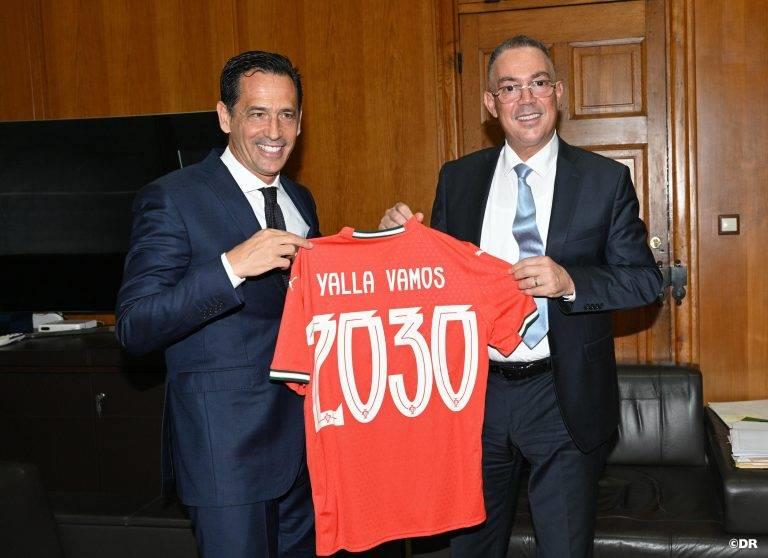

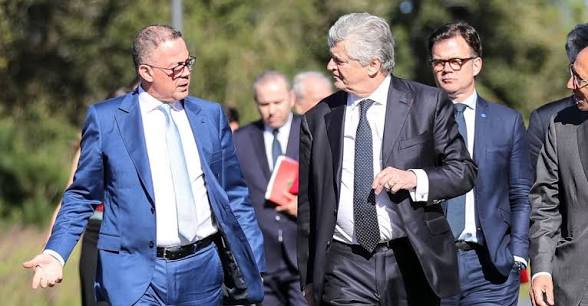
Chaired by the President of the Royal Moroccan Football Federation (FRMF) and the Morocco 2030 Foundation, Fouzi Lekjaa, this meeting was marked by the presence of the French Minister Delegate for Foreign Trade and Economic Attractiveness, Nicolas Forissier, the President of the Morocco Industry Group of the General Confederation of Moroccan Enterprises (CGEM), Mohamed Bachiri, and the President of the French Football Federation, Philippe Diallo.
Speaking on this occasion, Lekjaa noted that the 2030 World Cup constitutes a major milestone in the development project launched in Morocco over the past two decades, adding that the Kingdom will host major sporting events prior to the 2030 World Cup.
He stressed that economic operators from both countries are already working together on several ongoing projects, expressing his wish to benefit from French expertise in organizing large-scale sporting events, namely the Paris 2024 Olympic Games.
Lekjaa highlighted that a new component of cooperation will be dedicated to youth through football, with the objective of promoting values such as tolerance, fair play, and inclusion.
For his part, Nicolas Forissier told the press that his visit to Morocco is part of a series of bilateral meetings aimed at strengthening the excellent relationship between Morocco and France. He praised the importance of reinforcing the friendship between the two countries across several fields, particularly in the economy, industry, and agriculture.
The French official commended Morocco’s expertise and organizational capacity, as demonstrated during the Africa Cup of Nations, adding that France wishes to contribute its know-how to build a solid partnership on the ground.
He stated that, “beyond the economic aspect, this cooperation aims to materialize the friendship between the two peoples and offer a sense of dreams to the younger generations of both countries through sports and cooperation.”
Mohamed Bachiri, for his part, affirmed that beyond the sporting aspect, the 2030 World Cup constitutes a structuring economic project capable of transforming the national economy. He noted that this global football event is likely to mobilize massive investments, accelerate the modernization of strategic sectors, and create numerous employment opportunities for businesses.
According to him, events on the scale of the World Cup have a lasting impact on a country’s attractiveness and trajectory, citing the example of France with the 1998 World Cup and the Paris 2024 Olympics.
“Co-organized with Spain and Portugal, this competition positions Morocco at the heart of the Euro-Mediterranean space and represents a strategic bridge between Europe and Africa, based on the logic of proximity and co-development,” he analyzed, specifying that this Task Force meeting is part of a renewal of the historic partnership between Morocco and France.
On the sidelines of this meeting, a panel discussion regarding cooperation projects ahead of the 2030 World Cup brought together Moroccan companies and their French counterparts.